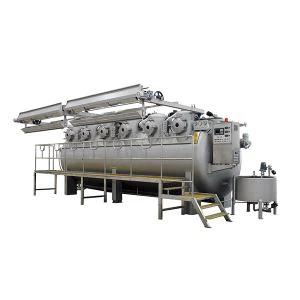
In the textile industry, the stability of dyeing quality is of paramount importance. As a supplier of Soft Flow Fabric Dyeing Machines, I have witnessed firsthand how these machines play a crucial role in ensuring consistent and high - quality dyeing results. In this blog, I will delve into the various aspects of how a Soft Flow Fabric Dyeing Machine guarantees the stability of dyeing quality.
1. Precise Temperature Control
One of the fundamental factors that affect dyeing quality is temperature. Different dyes require specific temperatures to achieve optimal dyeing effects. A Soft Flow Fabric Dyeing Machine is equipped with advanced temperature control systems. These systems can maintain a constant temperature throughout the dyeing process, with an accuracy of up to ±0.5°C in some high - end models.
The temperature control system typically consists of a heating element, a temperature sensor, and a control unit. The heating element, which can be electric or steam - based, is responsible for raising the temperature of the dye bath. The temperature sensor continuously monitors the temperature and sends feedback to the control unit. The control unit then adjusts the power supply to the heating element to keep the temperature within the set range.
For example, when dyeing polyester fabrics with disperse dyes, the dyeing temperature usually needs to be around 130°C. Any significant deviation from this temperature can lead to uneven dyeing, such as lighter or darker spots on the fabric. With the precise temperature control of a Soft Flow Fabric Dyeing Machine, these issues can be effectively avoided, ensuring the stability of dyeing quality.
2. Uniform Liquid Circulation
Uniform liquid circulation is another key factor in achieving consistent dyeing results. In a Soft Flow Fabric Dyeing Machine, a well - designed circulation system ensures that the dye liquor is evenly distributed throughout the fabric.
The circulation system usually includes a pump, pipes, and nozzles. The pump draws the dye liquor from the bottom of the dyeing tank and sends it through the pipes to the nozzles. The nozzles then spray the dye liquor onto the fabric in a controlled manner.
There are different types of nozzles available in Soft Flow Fabric Dyeing Machines. For instance, our Multi Nozzle Soft Flow Dyeing Machine is equipped with multiple nozzles that can spray the dye liquor from different angles. This multi - nozzle design helps to ensure that every part of the fabric comes into contact with the dye liquor evenly, reducing the risk of uneven dyeing.
Moreover, the flow rate of the dye liquor can be adjusted according to the type and thickness of the fabric. For thin and lightweight fabrics, a lower flow rate may be sufficient, while thicker and denser fabrics require a higher flow rate to ensure proper penetration of the dye liquor.
3. Accurate Dosing System
Accurate dosing of dyes and chemicals is essential for maintaining the stability of dyeing quality. A Soft Flow Fabric Dyeing Machine is often equipped with an accurate dosing system that can measure and dispense the required amount of dyes and chemicals precisely.
The dosing system can be either manual or automated. In an automated dosing system, the operator only needs to input the required amount of dyes and chemicals into the control panel. The system will then use sensors and pumps to measure and dispense the exact amount into the dye bath.
This accuracy is crucial because even a small deviation in the amount of dyes or chemicals can have a significant impact on the dyeing result. For example, if too much dye is added, the fabric may become over - dyed, resulting in a darker color than desired. On the other hand, if too little dye is added, the fabric may not reach the expected color intensity.
4. Gentle Fabric Handling
Soft Flow Fabric Dyeing Machines are designed to handle fabrics gently, which is important for maintaining the integrity of the fabric and ensuring consistent dyeing quality. Unlike some traditional dyeing methods that may subject the fabric to high mechanical stress, Soft Flow Fabric Dyeing Machines use a gentle flow of dye liquor to carry the fabric through the dyeing process.
The fabric is transported through the dyeing tank in a continuous loop, with the dye liquor flowing around it. This gentle movement reduces the risk of fabric damage, such as stretching, tearing, or pilling. Damaged fabric can absorb dyes unevenly, leading to inconsistent dyeing results.
For example, when dyeing delicate silk fabrics, the gentle handling of a Soft Flow Fabric Dyeing Machine ensures that the silk fibers remain intact, allowing for uniform dye absorption and a high - quality dyeing finish.
5. Advanced Control and Monitoring Systems
Modern Soft Flow Fabric Dyeing Machines are equipped with advanced control and monitoring systems that provide real - time information about the dyeing process. These systems allow operators to monitor and adjust various parameters, such as temperature, pressure, flow rate, and dosing, to ensure optimal dyeing conditions.
The control panel of the machine usually displays all the relevant information in a user - friendly interface. Operators can easily set the desired parameters and monitor the actual values during the dyeing process. If any parameter deviates from the set range, the system can send an alarm to alert the operator.


In addition, some advanced Soft Flow Fabric Dyeing Machines can store the dyeing recipes for different types of fabrics. This means that once a successful dyeing recipe is established, it can be easily recalled and used for future dyeing processes, ensuring consistent dyeing quality.
6. Compatibility with Different Fabrics
A good Soft Flow Fabric Dyeing Machine should be compatible with a wide range of fabrics, including natural fibers (such as cotton, silk, and wool), synthetic fibers (such as polyester, nylon, and acrylic), and blended fabrics.
Different fabrics have different dyeing requirements, such as different dye types, dyeing temperatures, and dyeing times. Soft Flow Fabric Dyeing Machines can be adjusted to meet these specific requirements. For example, our Jet Dyeing Machine For Cotton - ramie Fabrics is specifically designed to handle the unique characteristics of cotton - ramie blended fabrics, ensuring excellent dyeing results.
Similarly, our Jet Dyeing Machine For Rib Fabric High Pressure Rapid Dyeing Machine is suitable for rib fabrics, which often require a high - pressure and rapid dyeing process to achieve the desired color and texture.
Conclusion
In conclusion, a Soft Flow Fabric Dyeing Machine ensures the stability of dyeing quality through precise temperature control, uniform liquid circulation, accurate dosing, gentle fabric handling, advanced control and monitoring systems, and compatibility with different fabrics. These features work together to provide consistent and high - quality dyeing results, meeting the strict requirements of the textile industry.
If you are in the textile industry and are looking for a reliable Soft Flow Fabric Dyeing Machine to improve your dyeing quality, please feel free to contact us for more information and to discuss your specific needs. We are committed to providing you with the best solutions and excellent customer service.
References
- Textile Dyeing Technology Handbook, edited by John Smith, 2020
- Advances in Fabric Dyeing Equipment, published by the International Textile Research Institute, 2022