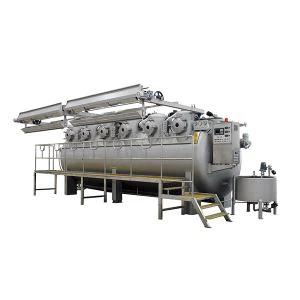
Can a Soft Flow Dyeing Machine be used for dyeing knitted fabrics?
As a leading supplier of Soft Flow Dyeing Machines, I often encounter questions from our clients about the versatility of our machines, especially regarding their suitability for dyeing knitted fabrics. In this blog post, I'll delve into the technical aspects, advantages, and potential limitations of using a Soft Flow Dyeing Machine for knitted fabric dyeing.
Understanding Soft Flow Dyeing Machines
Before we discuss the application to knitted fabrics, let's briefly understand what a Soft Flow Dyeing Machine is. A Soft Flow Dyeing Machine is designed to provide a gentle yet efficient dyeing process. It uses a combination of a soft flow of the dye liquor and mechanical action to ensure uniform dye penetration and color fastness. The machine typically consists of a dyeing vessel, a circulation system, and a heating and cooling mechanism.
One of our popular models is the HTHP Soft Flow Dyeing Machine. This machine operates under high temperature and high pressure conditions, which allows for a wider range of dyeing options and better color fixation. Another model, the Taffeta Fabric Dyeing Machine High - Pressure Rapid Dyeing Machine, is specifically engineered for high - pressure dyeing processes, enabling rapid and efficient dyeing. The Jet Dyeing Machine For Crepe Fabric is also part of our product line, which uses a jet - like flow of the dye liquor to ensure even dye distribution.
Suitability for Knitted Fabrics
Advantages
-
Gentle Handling
Knitted fabrics are known for their elasticity and delicate structure. The soft flow action of our dyeing machines ensures that the fabric is handled gently during the dyeing process. Unlike some other dyeing methods that may cause excessive stretching or distortion, the soft flow minimizes mechanical stress on the knitted fabric. This helps to maintain the fabric's original shape, texture, and elasticity, resulting in a high - quality dyed product. -
Uniform Dyeing
The circulation system in a Soft Flow Dyeing Machine ensures that the dye liquor is evenly distributed throughout the fabric. For knitted fabrics, which often have a complex structure with loops and spaces, uniform dye penetration is crucial. The continuous flow of the dye liquor helps to reach all parts of the fabric, including the inner layers of the loops, ensuring consistent color across the entire fabric surface. -
Color Fastness
The high - temperature and high - pressure capabilities of some of our Soft Flow Dyeing Machines, such as the HTHP Soft Flow Dyeing Machine, contribute to better color fastness. When dyeing knitted fabrics, good color fastness is essential to prevent color bleeding and fading during washing and wearing. The high - pressure environment helps the dye molecules to penetrate deeper into the fabric fibers, resulting in a more permanent color bond. -
Versatility in Dyeing Options
Soft Flow Dyeing Machines can accommodate a wide range of dyes, including reactive dyes, disperse dyes, and acid dyes. This versatility allows for different color effects and dyeing techniques on knitted fabrics. Whether you want to achieve a solid color, a gradient effect, or a multi - color pattern, our machines can be adjusted to meet your specific requirements.
Potential Limitations
- Fabric Density and Thickness
In some cases, very thick or densely knitted fabrics may pose a challenge. The dye liquor may have difficulty penetrating the fabric layers quickly enough, especially if the fabric has a tight stitch. However, with proper adjustment of the dyeing parameters, such as increasing the circulation time and flow rate of the dye liquor, this issue can often be overcome. - Specialty Knitted Fabrics
Some specialty knitted fabrics, such as those with metallic fibers or heat - sensitive materials, may require special attention. The high - temperature operation of certain Soft Flow Dyeing Machines may damage these specialty fabrics. In such cases, it is necessary to work closely with our technical team to develop a customized dyeing process that takes into account the unique properties of the fabric.
Process Considerations for Dyeing Knitted Fabrics
Pretreatment
Before dyeing, knitted fabrics usually require pretreatment to remove impurities, such as oils, waxes, and sizing agents. This pretreatment step is crucial for ensuring good dye uptake and uniform color. Our Soft Flow Dyeing Machines can be used for the pretreatment process as well. By adjusting the temperature, chemical concentration, and circulation time, we can effectively clean the fabric and prepare it for dyeing.


Dyeing Parameters
The dyeing parameters, including temperature, time, pH, and dye concentration, need to be carefully controlled when dyeing knitted fabrics. For example, different types of dyes have different optimal dyeing temperatures. Reactive dyes typically require a lower temperature compared to disperse dyes. The dyeing time also depends on the fabric type and the desired color depth. Our machines are equipped with advanced control systems that allow for precise adjustment of these parameters, ensuring consistent and reproducible dyeing results.
Post - treatment
After dyeing, post - treatment is necessary to improve the color fastness and remove any excess dye. This may involve washing, soaping, and fixing processes. Our Soft Flow Dyeing Machines can also be used for post - treatment, providing a seamless workflow from dyeing to finishing.
Case Studies
We have had numerous successful cases of using our Soft Flow Dyeing Machines for dyeing knitted fabrics. For example, a client who produces sportswear made of knitted polyester fabric wanted to achieve a bright and long - lasting color. By using our HTHP Soft Flow Dyeing Machine with disperse dyes, we were able to meet their requirements. The dyed fabric had excellent color fastness and maintained its elasticity and softness, which was highly appreciated by the client.
Another client who specialized in lingerie made of knitted nylon fabric needed a gentle dyeing process to preserve the fabric's delicate nature. Our Soft Flow Dyeing Machine provided the perfect solution. The machine's gentle handling ensured that the fabric remained intact, and the uniform dyeing result enhanced the overall appearance of the lingerie.
Conclusion
In conclusion, a Soft Flow Dyeing Machine is a highly suitable option for dyeing knitted fabrics. Its gentle handling, uniform dyeing capabilities, and versatility in dyeing options make it a valuable tool for the textile industry. While there may be some potential limitations, these can be addressed through proper process optimization and technical support.
If you are interested in using our Soft Flow Dyeing Machines for your knitted fabric dyeing needs, we invite you to contact us for further discussion. Our team of experts is ready to assist you in developing the most suitable dyeing process for your specific knitted fabrics. Whether you are a small - scale manufacturer or a large - scale textile mill, we can provide you with the right solution to achieve high - quality dyed knitted products.
References
- "Textile Dyeing and Finishing Technology" by X. M. Hou
- "Handbook of Textile Fibre Structure" by J. W. S. Hearle