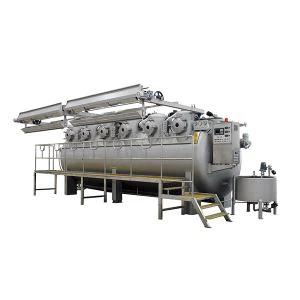
Hey there! I'm a supplier of cloth dyeing machines, and today I wanna chat about something super important in our industry: how these machines deal with wastewater. As you probably know, cloth dyeing involves a whole lot of water, and if we don't handle that wastewater right, it can cause some serious environmental problems. So, let's dive in and take a closer look at the process.
First off, let's talk about what's actually in that wastewater. When we dye cloth, we use all sorts of chemicals, like dyes, salts, and surfactants. These chemicals are what give the fabric its color and make the dyeing process work, but they also end up in the wastewater. On top of that, there are usually bits of fabric, lint, and other debris that get washed off during the dyeing process. So, the wastewater is a pretty messy mix of all these things.
The first step in dealing with this wastewater is usually to collect it. Most cloth dyeing machines have a system in place to gather all the used water and send it to a central location. This makes it easier to treat the water all at once. Once the water is collected, it goes through a series of treatment steps to remove the harmful chemicals and contaminants.
One of the most common methods for treating wastewater from cloth dyeing machines is called physical treatment. This involves using things like screens and filters to remove the larger particles of debris, like fabric pieces and lint. These physical barriers can catch a lot of the big stuff, which helps to make the water a bit cleaner right off the bat. After that, the water might go through a process called sedimentation. In sedimentation, the water is left to sit in a tank for a while, and the heavier particles sink to the bottom. This allows the cleaner water at the top to be separated from the sludge at the bottom.
But physical treatment alone isn't enough to get rid of all the chemicals in the wastewater. That's where chemical treatment comes in. There are a few different chemical processes that can be used, but one of the most common is called coagulation and flocculation. In coagulation, chemicals are added to the water to make the small particles in the water clump together. These clumps, called flocs, are then easier to remove. Flocculation is a similar process, but it involves gently stirring the water to help the flocs form and grow bigger. Once the flocs are large enough, they can be removed from the water using a process like sedimentation or filtration.
Another important chemical treatment method is oxidation. Oxidation involves using chemicals to break down the organic compounds in the wastewater. These organic compounds are often the dyes and other chemicals that give the wastewater its color and odor. By breaking them down, we can make the water less harmful and more environmentally friendly. One common oxidizing agent used in wastewater treatment is chlorine. Chlorine can react with the organic compounds in the water and break them down into simpler, less harmful substances.
After the physical and chemical treatments, the water might still have some remaining contaminants. That's where biological treatment comes in. Biological treatment uses microorganisms, like bacteria and fungi, to break down the remaining organic matter in the water. These microorganisms eat the organic compounds in the water and turn them into carbon dioxide and water. This is a natural and effective way to further clean the water. There are a few different types of biological treatment systems, including activated sludge systems and trickling filters.
Once the water has gone through all these treatment steps, it should be much cleaner and safer to discharge into the environment. However, in some cases, the treated water might still not meet the strict environmental standards. In these situations, the water might need to go through additional treatment steps, like reverse osmosis or advanced oxidation processes. Reverse osmosis involves forcing the water through a semi - permeable membrane to remove even the smallest particles and dissolved solids. Advanced oxidation processes use powerful oxidizing agents to break down any remaining contaminants.
Now, let's talk about how our cloth dyeing machines play a role in all of this. At our company, we design our machines to be as water - efficient as possible. For example, our [Jet Dyeing Machine For Cotton - ramie Fabrics](/soft - flow - dyeing - machine/jet - dyeing - machine - for - cotton - ramie - fabrics.html) is equipped with advanced water - recycling systems. These systems allow the machine to reuse a large portion of the water during the dyeing process, which not only reduces the amount of wastewater generated but also saves on water costs.
Our [Dyeing Machine For Tencel High Temperature Rapid Dyeing Machine](/soft - flow - dyeing - machine/dyeing - machine - for - tencel - high - temperature.html) is another great example. It has a precise control system that ensures the right amount of water and chemicals are used for each dyeing cycle. This helps to minimize waste and make the dyeing process more efficient. And our [Dyeing Machine For Crepe Fabric High Pressure Rapid Dyeing Machine](/soft - flow - dyeing - machine/dyeing - machine - for - crepe - fabric - high - pressure.html) is designed with a closed - loop system that further reduces the amount of wastewater that needs to be treated.
If you're in the market for a cloth dyeing machine, it's really important to consider how the machine deals with wastewater. Not only is it better for the environment, but it can also save you money in the long run. By choosing a machine with efficient water - recycling and wastewater - treatment features, you can reduce your water consumption and lower your treatment costs.
So, if you're interested in learning more about our cloth dyeing machines and how they can help you deal with wastewater in a more sustainable way, don't hesitate to reach out. We're always happy to have a chat and answer any questions you might have. Whether you're a small - scale dyer or a large textile factory, we've got the right machine for you.
In conclusion, dealing with wastewater from cloth dyeing machines is a multi - step process that involves physical, chemical, and biological treatments. Our machines are designed to be part of the solution, helping to reduce the amount of wastewater generated and making the treatment process more efficient. If you're looking for a reliable and environmentally - friendly cloth dyeing machine, get in touch with us, and let's start a conversation about your needs.
References


- "Textile Dyeing Wastewater Treatment: A Review" by various authors in a leading environmental science journal.
- "Handbook of Textile Dyeing Technology" which provides in - depth information on the dyeing process and wastewater management.