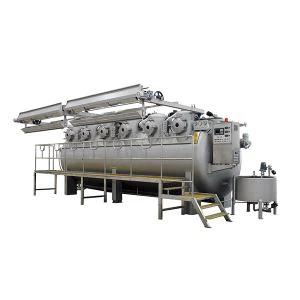
The loading capacity of a gas - liquid dyeing machine is a crucial factor that directly impacts the efficiency and productivity of textile dyeing processes. As a leading supplier of gas - liquid dyeing machines, we understand the significance of this parameter and are committed to providing machines with optimal loading capacities to meet the diverse needs of our customers.
Understanding the Concept of Loading Capacity
The loading capacity of a gas - liquid dyeing machine refers to the maximum amount of textile material that the machine can handle in a single dyeing cycle. It is typically measured in kilograms or pounds of fabric. This capacity is determined by several factors, including the size of the dyeing chamber, the design of the machine's circulation system, and the type of textile being dyed.
The size of the dyeing chamber is one of the most obvious determinants of loading capacity. A larger chamber can accommodate more fabric, allowing for higher production volumes. However, simply increasing the chamber size is not always the best solution. The machine's circulation system must be able to effectively distribute the dye and gas mixture throughout the entire load of fabric. If the circulation is poor, uneven dyeing may occur, leading to quality issues.
The type of textile also plays a role in determining the loading capacity. Different fabrics have different densities, thicknesses, and absorption rates. For example, lightweight and porous fabrics may require less space per unit weight compared to heavy - duty and tightly woven fabrics. Therefore, the loading capacity may vary depending on whether the machine is dyeing cotton, silk, polyester, or other types of textiles.
Factors Affecting the Loading Capacity
-
Machine Design and Structure
The internal structure of the gas - liquid dyeing machine has a significant impact on its loading capacity. Machines with a well - designed drum or chamber layout can maximize the use of space, allowing for more fabric to be loaded. For instance, some of our NTNP Gas - liquid Dyeing Machine models feature a unique drum design that provides a larger effective volume for fabric loading while ensuring uniform dyeing.
The construction of the machine's circulation pipes and nozzles also affects loading capacity. A well - engineered circulation system can ensure that the dye and gas mixture reaches all parts of the fabric, even when the machine is fully loaded. This is essential for achieving consistent dyeing results across the entire batch. -
Dyeing Process Requirements
The specific dyeing process requirements can limit or enhance the loading capacity. For example, some dyeing processes require a certain amount of space between the fabric layers to allow for proper penetration of the dye. If the fabric is packed too tightly, the dye may not be able to reach all areas, resulting in uneven coloration.
On the other hand, some advanced dyeing techniques may allow for higher loading capacities. For example, our Normal Temperature Gas - liquid Dyeing Machine for Fabric uses a unique gas - liquid combination technology that can achieve good dyeing results even with relatively high fabric loads at normal temperatures. -
Fabric Characteristics
As mentioned earlier, the characteristics of the fabric, such as its weight, density, and texture, have a direct impact on the loading capacity. Lightweight fabrics like chiffon can be loaded in larger quantities compared to heavy - weight denim. Additionally, fabrics with a high absorbency may require more space to ensure that the dye is evenly distributed.
The width and length of the fabric also matter. Longer and wider fabrics may need to be folded or arranged in a specific way to fit into the dyeing chamber, which can affect the overall loading capacity.
Measuring and Optimizing Loading Capacity
To accurately measure the loading capacity of a gas - liquid dyeing machine, it is necessary to conduct practical tests with different types of fabrics. These tests should take into account the dyeing process requirements, such as the dyeing time, temperature, and pressure. By running multiple tests, we can determine the maximum amount of fabric that can be dyed uniformly without compromising the quality of the final product.
To optimize the loading capacity, several strategies can be employed. First, the fabric can be pre - treated to improve its dye - absorption properties. This can reduce the need for excessive dye and allow for more fabric to be loaded. Second, the machine's operating parameters, such as the circulation speed and pressure, can be adjusted to ensure better dye distribution even at higher loads.
Our High Temperature High Pressure Liquid Dyeing Machine is designed with advanced control systems that allow for precise adjustment of these parameters. This enables our customers to optimize the loading capacity based on their specific fabric and dyeing requirements.
Importance of Loading Capacity in the Textile Industry
In the textile industry, the loading capacity of a dyeing machine is closely related to production efficiency and cost - effectiveness. A machine with a high loading capacity can process more fabric in a single cycle, reducing the number of dyeing cycles required to complete a large order. This not only saves time but also reduces energy consumption and labor costs.
Moreover, a higher loading capacity can improve the overall competitiveness of textile manufacturers. By being able to produce more dyed fabric in a shorter time, manufacturers can meet customer demands more quickly and potentially offer more competitive prices.


Conclusion
The loading capacity of a gas - liquid dyeing machine is a complex parameter that is influenced by multiple factors, including machine design, dyeing process requirements, and fabric characteristics. As a supplier of gas - liquid dyeing machines, we are constantly researching and developing new technologies to improve the loading capacity of our machines while maintaining high - quality dyeing results.
If you are in the textile industry and are looking for a gas - liquid dyeing machine with an optimal loading capacity, we invite you to contact us for more information. Our team of experts is ready to assist you in selecting the right machine for your specific needs and to provide you with professional advice on how to optimize its performance.
References
- Textile Dyeing Technology Handbook.
- Research Papers on Gas - Liquid Dyeing Machine Design and Performance.