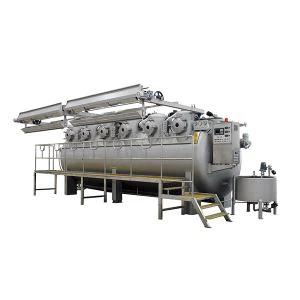
Can a cloth dyeing machine be integrated with other textile equipment? This is a question that many in the textile industry have pondered, and as a leading cloth dyeing machine supplier, I'm excited to delve into this topic.
The Concept of Integration in the Textile Industry
In the modern textile industry, the pursuit of efficiency, quality, and sustainability has led to the exploration of equipment integration. Integration refers to the seamless connection and coordinated operation of different types of textile equipment to form a unified production system. This approach can bring numerous benefits, such as reduced production time, improved product quality, and lower costs.
Advantages of Integrating Cloth Dyeing Machines with Other Textile Equipment
1. Enhanced Production Efficiency
When a cloth dyeing machine is integrated with other textile equipment, such as a weaving machine or a finishing machine, the overall production process can be streamlined. For example, the seamless transfer of fabric from the weaving stage directly to the dyeing machine without manual handling can significantly reduce the time and labor required. This continuous flow of production can increase the output of the entire textile production line.
2. Improved Product Quality
Integration allows for better control of the production process. For instance, when the dyeing machine is integrated with a quality control system, real - time monitoring of dyeing parameters such as temperature, pressure, and color fastness can be achieved. This ensures that the dyed fabric meets the desired quality standards consistently. Moreover, the coordinated operation of different equipment can prevent damage to the fabric during the transfer between various production stages, further enhancing the final product quality.
3. Cost Savings
By integrating cloth dyeing machines with other textile equipment, companies can save on costs in several ways. Firstly, the reduction in labor costs due to the automation of the production process is significant. Secondly, the optimized use of resources such as water, energy, and dyes can be achieved. For example, integrated systems can recycle and reuse water and dyes more effectively, reducing waste and saving on raw material costs.
Types of Textile Equipment That Can Be Integrated with Cloth Dyeing Machines
1. Weaving Machines
Integrating a cloth dyeing machine with a weaving machine can create a continuous production process from fabric formation to dyeing. After the fabric is woven, it can be directly fed into the dyeing machine. This eliminates the need for intermediate storage and handling, reducing the risk of fabric damage and improving the overall production efficiency.
2. Finishing Machines
Finishing machines are used to improve the appearance, feel, and performance of the dyed fabric. By integrating the dyeing machine with finishing equipment, such as a calendering machine or a coating machine, the fabric can undergo a series of treatments in a continuous manner. This not only saves time but also ensures a more uniform finish on the fabric.
3. Quality Control Equipment
As mentioned earlier, integrating quality control equipment with the dyeing machine can help maintain high - quality standards. Sensors and monitoring devices can be installed to measure and control various dyeing parameters. If any deviation from the set standards is detected, the system can automatically adjust the dyeing process, ensuring consistent product quality.
Our Cloth Dyeing Machines and Their Integration Potential
We offer a wide range of cloth dyeing machines, each with its unique features and capabilities that make them suitable for integration with other textile equipment.
TH - VA - B Low Bath Ratio Fabric Dyeing Machine Enviromental Friendly
Our TH - VA - B Low Bath Ratio Fabric Dyeing Machine Enviromental Friendly is designed with advanced technology to minimize water and energy consumption. Its low bath ratio design not only makes it environmentally friendly but also allows for easy integration with other equipment. The machine can be connected to a central control system, which can coordinate its operation with other textile machines in the production line. This ensures that the dyeing process is synchronized with other production stages, improving overall efficiency.
Normal Temperature Overflow Dyeing Machine for Fabric
The Normal Temperature Overflow Dyeing Machine for Fabric is another excellent option for integration. It operates at normal temperatures, which is suitable for a wide range of fabrics. This machine can be integrated with a fabric feeding system from a weaving machine, allowing for a smooth transition of the fabric from weaving to dyeing. Additionally, it can be connected to a quality control system to monitor the dyeing process in real - time.
High Temperature Overflow Dyeing Machine
Our High Temperature Overflow Dyeing Machine is ideal for dyeing synthetic fabrics that require high - temperature treatment. It can be integrated with pre - treatment equipment, such as a scouring machine, to ensure that the fabric is properly prepared before dyeing. The high - temperature dyeing process can be precisely controlled when integrated with a temperature control system, which is essential for achieving consistent dyeing results.
Challenges in Integrating Cloth Dyeing Machines with Other Textile Equipment
1. Compatibility Issues
One of the main challenges in integration is the compatibility of different equipment. Different machines may have different communication protocols, control systems, and mechanical interfaces. Ensuring that these machines can communicate and work together seamlessly requires careful planning and the use of appropriate adapters and software.


2. Technical Expertise
Integrating textile equipment requires a high level of technical expertise. Operators need to be trained to understand and manage the integrated system. Additionally, maintenance and troubleshooting of the integrated system can be more complex than that of individual machines. Companies need to invest in training their staff or hire specialized technicians to handle these tasks.
3. Initial Investment
The initial investment required for integrating cloth dyeing machines with other textile equipment can be substantial. This includes the cost of purchasing new equipment, installing communication systems, and modifying existing production facilities. However, it's important to note that the long - term benefits in terms of efficiency, quality, and cost savings often outweigh the initial investment.
Conclusion
In conclusion, a cloth dyeing machine can indeed be integrated with other textile equipment, and the benefits of such integration are significant. Despite the challenges, the potential for enhanced production efficiency, improved product quality, and cost savings make it a worthwhile investment for textile companies. Our range of cloth dyeing machines, including the TH - VA - B Low Bath Ratio Fabric Dyeing Machine Enviromental Friendly, Normal Temperature Overflow Dyeing Machine for Fabric, and High Temperature Overflow Dyeing Machine, are designed to be easily integrated into various textile production lines.
If you are interested in exploring the integration of our cloth dyeing machines with your existing textile equipment or starting a new integrated production line, we invite you to contact us for a detailed discussion. Our team of experts will be happy to provide you with customized solutions based on your specific needs.
References
- Smith, J. (2020). Textile Equipment Integration: A Review. Journal of Textile Technology, 15(2), 45 - 56.
- Brown, A. (2019). The Benefits of Integrating Dyeing Machines in Textile Production. Textile World, 30(3), 67 - 78.
- Green, C. (2021). Challenges and Solutions in Textile Equipment Integration. International Journal of Textile Engineering, 22(4), 89 - 100.