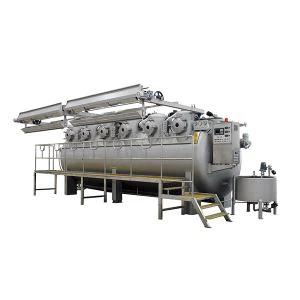
As a supplier of High Temperature Overflow Dyeing Machines, I often encounter inquiries from customers about the versatility of our equipment. One of the most frequently asked questions is whether a High Temperature Overflow Dyeing Machine can be used for continuous dyeing. In this blog post, I will delve into this topic, exploring the capabilities and limitations of our machines in the context of continuous dyeing processes.
Understanding High Temperature Overflow Dyeing Machines
Before discussing the suitability of High Temperature Overflow Dyeing Machines for continuous dyeing, it is essential to understand their basic principles and functions. These machines are designed to dye fabrics in a batch process, where a specific quantity of fabric is loaded into the dyeing vessel along with the dye liquor. The machine then circulates the dye liquor through the fabric at high temperatures and pressures, ensuring uniform dye penetration and color fastness.
The key features of High Temperature Overflow Dyeing Machines include:
- High Temperature Capability: These machines can operate at temperatures up to 140°C, allowing for the use of dyes that require high heat for fixation.
- Overflow System: The overflow system ensures continuous circulation of the dye liquor through the fabric, preventing uneven dyeing and promoting better color distribution.
- Automation and Control: Modern High Temperature Overflow Dyeing Machines are equipped with advanced automation and control systems, allowing for precise control of temperature, pressure, and dyeing time.
Can a High Temperature Overflow Dyeing Machine be Used for Continuous Dyeing?
The short answer is yes, a High Temperature Overflow Dyeing Machine can be used for continuous dyeing, but with some limitations. Continuous dyeing is a process where the fabric is dyed continuously as it passes through a series of dyeing units. This process is typically used for large-scale production and offers several advantages, including higher productivity, lower labor costs, and better color consistency.
However, High Temperature Overflow Dyeing Machines are primarily designed for batch dyeing, which means they are not optimized for continuous dyeing. The main challenges of using a High Temperature Overflow Dyeing Machine for continuous dyeing include:
- Limited Fabric Capacity: High Temperature Overflow Dyeing Machines have a limited fabric capacity, which means they may not be suitable for high-volume continuous dyeing operations.
- Batch-to-Batch Variation: Batch dyeing processes are inherently prone to batch-to-batch variation, which can affect the color consistency of the dyed fabric.
- Dyeing Time: Continuous dyeing processes typically require shorter dyeing times than batch dyeing processes, which may not be achievable with a High Temperature Overflow Dyeing Machine.
Overcoming the Challenges
Despite these challenges, there are several ways to overcome the limitations of using a High Temperature Overflow Dyeing Machine for continuous dyeing. One approach is to modify the machine to accommodate continuous dyeing processes. This may involve adding a continuous fabric feeding system, a continuous dyeing unit, and a continuous fabric drying system.


Another approach is to use a combination of batch and continuous dyeing processes. For example, the fabric can be pre-dyed in a High Temperature Overflow Dyeing Machine to achieve a base color, and then the final color can be applied using a continuous dyeing process. This approach allows for the benefits of both batch and continuous dyeing processes, while minimizing their limitations.
Advantages of Using a High Temperature Overflow Dyeing Machine for Continuous Dyeing
While there are challenges associated with using a High Temperature Overflow Dyeing Machine for continuous dyeing, there are also several advantages. These include:
- Flexibility: High Temperature Overflow Dyeing Machines offer greater flexibility than traditional continuous dyeing machines, allowing for the dyeing of a wider range of fabrics and colors.
- Cost-Effectiveness: High Temperature Overflow Dyeing Machines are generally less expensive than traditional continuous dyeing machines, making them a more cost-effective option for small to medium-sized dyeing operations.
- Quality Control: Batch dyeing processes offer greater control over the dyeing process, which can result in higher quality dyed fabric.
Our Product Range
At our company, we offer a range of High Temperature Overflow Dyeing Machines that are suitable for both batch and continuous dyeing processes. Our machines are designed to meet the highest standards of quality and performance, and are equipped with advanced features such as:
- Ultra Low Bath Ratio Energy Saving Dyeing Machine: This machine is designed to reduce water and energy consumption, making it a more environmentally friendly option. Ultra Low Bath Ratio Energy Saving Dyeing Machine
- High Temperature Soft Flow Dyeing Machine: This machine is designed to provide gentle and uniform dyeing of delicate fabrics, such as silk and wool. High Temperature Soft Flow Dyeing Machine
- Normal Temperature Overflow Dyeing Machine for Fabric: This machine is designed to dye fabrics at normal temperatures, making it a suitable option for a wide range of fabrics and dyes. Normal Temperature Overflow Dyeing Machine for Fabric
Conclusion
In conclusion, a High Temperature Overflow Dyeing Machine can be used for continuous dyeing, but with some limitations. While batch dyeing processes are generally more suitable for small to medium-sized dyeing operations, continuous dyeing processes offer several advantages for high-volume production. By modifying the machine or using a combination of batch and continuous dyeing processes, it is possible to overcome the limitations of using a High Temperature Overflow Dyeing Machine for continuous dyeing.
If you are interested in learning more about our High Temperature Overflow Dyeing Machines or would like to discuss your specific dyeing requirements, please contact us. Our team of experts will be happy to assist you in finding the right solution for your business.
References
- "Textile Dyeing and Finishing Technology" by M. S. Alam
- "Handbook of Textile and Industrial Dyeing" edited by K. L. Mittal