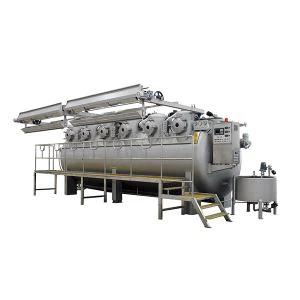
Hey there! As a supplier of the Rapid Jet Fabric Dyeing Machine, I often get asked about how our machine handles fabric lint during the dyeing process. It's a crucial question because fabric lint can mess up the dyeing results and cause all sorts of headaches. So, let's dive into how our Rapid Jet Fabric Dyeing Machine tackles this issue.
First off, what exactly is fabric lint? Well, it's those tiny fibers that come loose from the fabric during handling, cutting, or even just normal wear and tear. When you're dyeing fabric, these little lint particles can float around in the dye bath and stick to the fabric, leaving uneven dyeing, spots, or even clogging up the machine's pipes and nozzles.
Our Rapid Jet Fabric Dyeing Machine is designed with several features to deal with fabric lint effectively. One of the key components is the built - in lint filter. This filter is like a little hero that sits right in the dyeing system. As the dye liquor circulates through the machine, the lint filter traps the lint particles, preventing them from recirculating and causing problems.
The lint filter in our machine is made of a special material that has a high filtration efficiency. It can catch even the tiniest lint fibers, ensuring that the dye bath stays clean. And here's the cool part: it's easy to clean. You don't have to be a rocket scientist to take it out, rinse it off, and put it back in. This means less downtime for maintenance and more time for productive dyeing.
Another way our machine handles fabric lint is through its advanced circulation system. The dye liquor in the Rapid Jet Fabric Dyeing Machine is circulated at a high speed. This high - speed circulation creates a strong flow that helps to dislodge any lint that might be stuck to the fabric. The lint then gets carried away with the flow and into the lint filter.
The high - speed circulation also ensures that the dye is evenly distributed throughout the fabric. This is important because if the dye isn't evenly distributed, it can create areas where the lint is more likely to stick. By having a well - circulated dye bath, we reduce the chances of lint problems right from the start.
Let's talk about the type of fabrics our machine can handle. We've got a wide range of options. For example, if you're working with milk silk fabric, our Jet Dyeing Machine For Milk Silk Fabric is a great choice. Milk silk fabric can produce a fair amount of lint, but our machine's lint - handling features make sure that the dyeing process goes smoothly.
If you're dealing with high - temperature dyeing, our High Temperature Fabric Dyeing Machine is up to the task. High - temperature dyeing can sometimes make the fabric more prone to shedding lint, but our machine's lint filter and circulation system are designed to work under these conditions.
For knit fabrics, our HTHP Knit Fabric Dyeing Machine is the go - to. Knit fabrics can have a lot of loose fibers, but our machine can handle them with ease. The high - pressure and high - temperature environment in the HTHP machine, combined with the lint - handling features, ensure a perfect dyeing result.
Now, let's look at some real - world scenarios. Say you're running a small - scale textile dyeing business. You've got a batch of fabric that's known to shed a lot of lint. With our Rapid Jet Fabric Dyeing Machine, you don't have to worry about ruining the whole batch. The lint filter will do its job, and the high - speed circulation will keep the dye bath clean. You'll end up with beautifully dyed fabric that meets your customers' standards.
On the other hand, if you're a large - scale textile manufacturer, efficiency is key. Our machine's easy - to - clean lint filter means you can quickly get back to production after a cleaning. And the fact that it can handle different types of fabrics with different lint levels means you can use it for a wide variety of dyeing jobs.
In addition to the mechanical features, we also offer some tips on how to minimize fabric lint before the dyeing process. For example, you can pre - wash the fabric to remove loose fibers. This simple step can significantly reduce the amount of lint that ends up in the dye bath.
We also recommend using the right type of dyes and chemicals. Some dyes and chemicals can cause the fabric to shed more lint. By choosing the right ones, you can further reduce the lint problem.
If you're still not convinced about how well our Rapid Jet Fabric Dyeing Machine handles fabric lint, we offer demonstrations. You can come to our facility and see the machine in action. Watch as it filters out the lint, circulates the dye evenly, and produces high - quality dyed fabric.
In conclusion, our Rapid Jet Fabric Dyeing Machine is a top - notch solution for handling fabric lint during the dyeing process. With its built - in lint filter, advanced circulation system, and ability to handle different types of fabrics, it's a reliable choice for any textile dyeing business.
If you're interested in learning more about our Rapid Jet Fabric Dyeing Machine or want to discuss your specific dyeing needs, don't hesitate to reach out. We're here to help you take your textile dyeing to the next level. Contact us to start a conversation about how our machine can benefit your business.
References

- Textile Dyeing Technology Handbook
- Research on Fabric Lint Control in Dyeing Processes