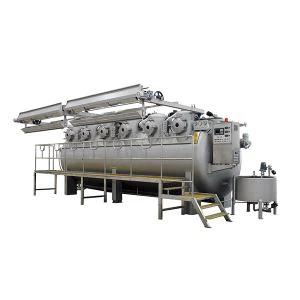
In the textile industry, the Atmospheric Soft Flow Dyeing Machine stands as a cornerstone of efficient and high - quality fabric dyeing. As a supplier of Atmospheric Soft Flow Dyeing Machines, I've witnessed firsthand the transformative impact of sensors in these machines. Sensors play a multifaceted and indispensable role in ensuring the optimal performance, quality control, and efficiency of the dyeing process.
Temperature Sensing
One of the most critical aspects of the dyeing process is temperature control. Different dyes require specific temperatures to bond effectively with the fabric fibers. Temperature sensors in an Atmospheric Soft Flow Dyeing Machine are responsible for continuously monitoring the temperature of the dye bath. These sensors are typically placed at strategic locations within the dyeing chamber to ensure accurate readings.
The data collected by the temperature sensors is sent to the machine's control system. If the temperature deviates from the set value, the control system can adjust the heating or cooling elements accordingly. For example, if the temperature is too low, the heating system will be activated to raise the temperature to the desired level. On the other hand, if the temperature is too high, the cooling system will kick in to prevent overheating, which could damage the fabric or cause uneven dyeing.
Accurate temperature control is essential for achieving consistent color results across different batches of fabric. It also helps to reduce energy consumption by preventing unnecessary heating or cooling. By maintaining the optimal temperature throughout the dyeing process, we can ensure that the dyes are applied evenly, resulting in high - quality, vibrant fabrics.
Pressure Sensing
Pressure sensors are another vital component in an Atmospheric Soft Flow Dyeing Machine. The pressure within the dyeing chamber affects the flow of the dye liquor and the movement of the fabric. These sensors monitor the pressure inside the chamber and transmit the data to the control system.

Proper pressure regulation is crucial for ensuring that the fabric moves smoothly through the dyeing machine. If the pressure is too low, the fabric may not move at the desired speed, leading to uneven dyeing. Conversely, if the pressure is too high, it could cause damage to the fabric or put excessive stress on the machine's components.
The control system uses the pressure sensor data to adjust the pressure - regulating valves. For instance, if the pressure is below the set point, the valves can be opened slightly to increase the pressure. If the pressure is too high, the valves can be closed to reduce it. This real - time pressure control helps to maintain a stable and efficient dyeing process, improving the overall quality of the dyed fabric.
Flow Rate Sensing
Flow rate sensors are used to measure the speed at which the dye liquor flows through the machine. The flow rate of the dye liquor is directly related to the distribution of the dye on the fabric. A consistent and appropriate flow rate is necessary to ensure that the dye is evenly applied to the fabric surface.
These sensors are installed in the pipes that carry the dye liquor. They measure the volume of the dye liquor passing through a specific point per unit of time. The control system uses this information to adjust the pumps that circulate the dye liquor. If the flow rate is too low, the pumps can be adjusted to increase the speed of the dye liquor flow. If the flow rate is too high, the pumps can be slowed down.
Maintaining the correct flow rate is essential for achieving uniform dyeing. It also helps to prevent issues such as dye pooling or streaking on the fabric. By accurately controlling the flow rate, we can ensure that the dye is distributed evenly across the entire fabric, resulting in a more consistent and attractive color.
Level Sensing
Level sensors are used to monitor the amount of dye liquor in the dyeing chamber. Maintaining the correct level of the dye liquor is crucial for the proper functioning of the dyeing machine. If the level is too low, the fabric may not be fully submerged in the dye liquor, leading to uneven dyeing. If the level is too high, it could cause the dye liquor to overflow, resulting in a messy and wasteful situation.
The level sensors are typically placed at different heights inside the dyeing chamber. They detect the liquid level and send signals to the control system. The control system can then activate the filling or draining mechanisms as needed. For example, if the level is too low, the system can open the valve to add more dye liquor. If the level is too high, the system can open the drain valve to remove the excess.
Accurate level sensing helps to ensure that the fabric is always in contact with the dye liquor at the appropriate depth, improving the dyeing quality and reducing waste.
pH Sensing
The pH level of the dye liquor has a significant impact on the dyeing process. Different dyes have different optimal pH ranges for effective bonding with the fabric fibers. pH sensors are used to measure the acidity or alkalinity of the dye liquor in the Atmospheric Soft Flow Dyeing Machine.
These sensors are immersed in the dye liquor and continuously monitor the pH value. The data is sent to the control system, which can adjust the pH by adding appropriate chemicals. For example, if the pH is too high (alkaline), an acid can be added to lower it. If the pH is too low (acidic), an alkali can be added to raise it.
Maintaining the correct pH level is essential for achieving the desired color intensity and fastness. Incorrect pH levels can lead to poor dye uptake, color variations, and reduced color fastness. By using pH sensors to control the pH of the dye liquor, we can ensure that the dyes bond effectively with the fabric, resulting in high - quality, long - lasting colors.
The Impact of Sensor Technology on Our Products
As a supplier of Atmospheric Soft Flow Dyeing Machines, the integration of advanced sensor technology has had a profound impact on the quality and performance of our products. Our machines equipped with high - precision sensors can achieve more accurate and consistent dyeing results. This has led to increased customer satisfaction, as our customers can rely on our machines to produce high - quality dyed fabrics with minimal color variations.
Moreover, the use of sensors has also improved the energy efficiency of our machines. By accurately controlling temperature, pressure, flow rate, and other parameters, we can reduce energy consumption and waste. This not only benefits the environment but also helps our customers save on operating costs.
We offer a range of Atmospheric Soft Flow Dyeing Machines, such as the Jet Dyeing Machine For Cotton - ramie Fabrics, TH - VA - B Low Bath Ratio Fabric Dyeing Machine Enviromental Friendly, and Dyeing Machine For Crepe Fabric High Pressure Rapid Dyeing Machine. All these machines are equipped with state - of - the - art sensors to ensure optimal performance.
Conclusion
In conclusion, sensors play a crucial role in an Atmospheric Soft Flow Dyeing Machine. They are responsible for monitoring and controlling various parameters such as temperature, pressure, flow rate, level, and pH. By providing accurate data to the control system, sensors enable the machine to maintain optimal operating conditions, resulting in high - quality, consistent dyeing results.
As a supplier, we are committed to continuously improving our products by integrating the latest sensor technology. If you are in the textile industry and looking for a reliable Atmospheric Soft Flow Dyeing Machine, we encourage you to contact us for more information and to discuss your specific requirements. Our team of experts is ready to assist you in finding the perfect solution for your dyeing needs.
References
- Textile Dyeing Technology Handbook, published by [Publisher Name]
- Advances in Sensor Technology for Industrial Applications, edited by [Editor Name]
- Research Papers on Atmospheric Soft Flow Dyeing Machines from [Journal Name]