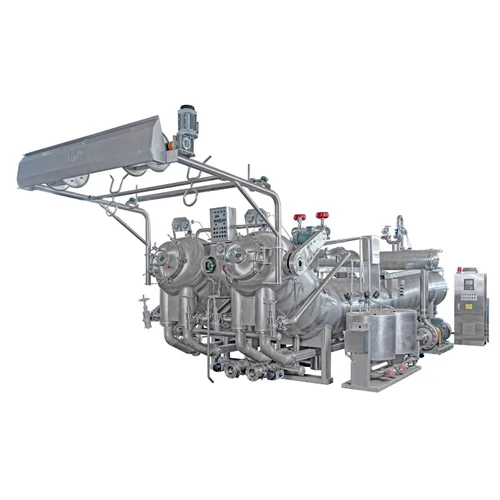
Printing and dyeing technology dry goods: The soft flow dyeing machine is not sensitive to the wrinkles of the semi-products. After dyeing, the fabric has a uniform color, fullness and good hand feeling. Especially after the chemical fiber and blended fabrics are processed by the overflow dyeing machine, the fabric feels soft, elastic and has Good hair style and cotton-like effect. There are many factors that affect the quality of overflow dyeing, and the most difficult quality problem is the level of dyeing on the surface of the fabric.
1. The influence of the capacity of the soft flow dyeing machine
Soft flow dyeing machines have a maximum nominal capacity, and this nominal capacity is not suitable for any fabric. Therefore, in production, the actual capacity of the overflow dyeing machine needs to be determined according to the thickness, width, and other conditions of the fabric. For fabrics of the same width, the thinner and lighter the fabric, the smaller the capacity. This is because if thin and light fabrics are fed according to the nominal capacity, the length of the fabric will inevitably be too long, and the cycle time during dyeing will be long, which will easily make the fabric knotted in the dyeing room due to disorder and cause fabric mottling.
2. The influence of winch speed and nozzle pressure
The fabric in the dyeing room is drawn into the nozzle by a winch. The nozzle is a ring-shaped outlet, and the dye solution is sprayed from the gap of the nozzle. With the pressure of the nozzle, the dye solution is sprayed on the rope-shaped fabric, and the speed of the fabric is determined by the speed of the winch. And nozzle pressure. In the temperature region where the fabric absorbs the dye, increasing the number of cycles of the fabric, that is, increasing the running speed of the fabric, is conducive to the leveling of the fabric. When the liquid volume is constant, by increasing the dyeing liquid flow rate (that is, increasing the nozzle pressure), the number of cycles of the dyeing liquid can be increased, the temperature in the dyeing machine, the uniformity of the dye distribution, and the number of contact between the dye and the fabric are increased, and the dyeing time shorten.
While increasing the fabric speed and increasing the number of dye liquor circulation, attention should be paid to the mutual cooperation between the winch speed and the nozzle pressure, otherwise it will directly affect the product quality. For example, if the winch speed is too slow and the nozzle pressure is too high, then the cloth speed is greater than the winch speed, which will easily cause fabric scratches; if the winch speed is too fast and exceeds the nozzle's ability to pass through the fabric, the fabric will accumulate at the nozzle. Blocking the nozzles causes the dyeing machine to stop running, causing fabric spots.
3. The influence of bath ratio
The liquor ratio not only affects the color of the fabric, but also affects the normal operation of the fabric in the dyeing machine. If the liquor ratio is too small, the fabric will be difficult to run, the winch will not be able to lift the fabric from the dyeing room smoothly, and the fabric will run slowly. If the bath ratio is too large, the fabric floats on the water surface, and it is prone to disorder and knotting, causing the fabric to be dyed. Furthermore, if the bath ratio is too large, it will inevitably increase the amount of dyes and additives, and at the same time increase the labor intensity of the batching operation. Therefore, the determination of the bath ratio should be as small as possible without affecting the operation of the fabric and ensuring the quality of dyeing.
4. The influence of dyeing process
(1) The main factors that affect the quality of the dye overflow dyeing machine are the dye use and adding method, dyeing temperature, salt and alkali agent type, dosage and adding method, dyeing time, dye liquor bath ratio and so on. Among the above influencing factors, in addition to the way of adding dyes, salts, and alkalis, and the bath ratio, the other factors only affect the color depth of the fabric, that is, the factors that affect the fixation rate of reactive dyes.
(2) For disperse dyes. For disperse dye dyeing at 90°C, the heating rate can be higher, and above 90°C, especially close to 130°C, the heating rate should be controlled to slowly approach the dyeing temperature to avoid uneven dyeing. The dyeing of disperse dyes is strongly affected by temperature. Therefore, in the temperature region where the dye is absorbed, increasing the number of cycles of the fabric and the dye liquor can make the dye and temperature distribution in the dyeing room even, which is beneficial to the level dyeing of the fabric.
After the dyeing is finished, the temperature should be lowered slowly at the beginning to avoid the fabric wrinkles caused by the sudden cooling. When the temperature drops to 100°C, the temperature can be quickly lowered to 80°C, and then overflow cleaning is performed to further reduce the temperature in the dyeing room. If the discharge and water inflow are carried out at a higher temperature, it is easy to form fabric creases and affect the dyeing quality.
https://www.tonghuadyeingmachine.com/