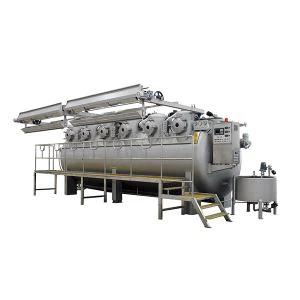
Hey there! As a supplier of HTHP Jet Dyeing Machines, I've seen firsthand how different factors can affect the dyeing process. One question that often comes up is, "What is the effect of fabric width on dyeing in an HTHP Jet Dyeing Machine?" Well, let's dive right in and explore this topic.
First off, let's understand what an HTHP Jet Dyeing Machine is. It's a high - tech piece of equipment used in the textile industry for dyeing fabrics at high temperatures and pressures. These machines are super efficient and can handle a variety of fabrics, from delicate silks to heavy - duty denims.
Now, when it comes to fabric width, it can have a significant impact on the dyeing process. One of the main effects is on the flow of the dye liquor. In an HTHP Jet Dyeing Machine, the dye liquor is circulated through the fabric to ensure even coloration. When the fabric width is narrow, the dye liquor can flow more freely around and through the fabric. This means that the dye can penetrate the fibers more easily, resulting in a more uniform color.
For example, if you're dyeing a narrow strip of fabric, say a ribbon, the dye will have less resistance as it moves through the fabric. The high - pressure jet in the machine can push the dye liquor deep into the fibers, and the circulation system can quickly distribute the dye evenly. This leads to a vibrant and consistent color across the entire width of the ribbon.
On the other hand, when the fabric width is wide, things get a bit more complicated. The dye liquor has to cover a larger surface area, and there's a greater chance of uneven flow. This can cause some parts of the fabric to receive more dye than others. In a wide fabric, the center of the fabric may not get as much contact with the dye liquor as the edges. This can result in a color variation, where the edges are darker and the center is lighter.
Let's take a large piece of upholstery fabric as an example. When you put it in the HTHP Jet Dyeing Machine, the dye liquor has to spread out over a wide area. If the machine's circulation system isn't properly adjusted, the dye may not reach all parts of the fabric evenly. This can lead to a less - than - perfect dyeing result, which is a big no - no in the textile industry.
Another aspect affected by fabric width is the dyeing time. Narrow fabrics generally require less dyeing time. Since the dye can penetrate quickly and evenly, the fabric can reach the desired color in a shorter period. This is great for production efficiency, as you can process more batches of narrow fabrics in a day.
For wide fabrics, however, the dyeing time needs to be longer. The machine has to run for more extended periods to ensure that the dye penetrates the entire width of the fabric. This not only increases the production time but also consumes more energy.
Now, as a supplier of HTHP Jet Dyeing Machines, we've developed some solutions to deal with these issues related to fabric width. Our TH-VA High-Pressure Rapid Dyeing Machine For Terry Fabric is designed with a special circulation system that can handle different fabric widths more effectively. It can adjust the flow of the dye liquor based on the width of the fabric, ensuring more even coloration.
The HTHP Dual Flow Fabric Dyeing Machine is another great option. It has two separate flow paths for the dye liquor, which helps in distributing the dye more evenly across wide fabrics. This reduces the chances of color variation and improves the overall dyeing quality.
Our High Temperature Fabric Dyeing Machine is also equipped with advanced controls that allow operators to optimize the dyeing process according to the fabric width. You can adjust the pressure, flow rate, and dyeing time to get the best results, whether you're working with narrow or wide fabrics.
In addition to these technical solutions, proper pre - treatment of the fabric is also crucial. Before dyeing, the fabric should be cleaned and prepared to ensure that it can absorb the dye evenly. This is especially important for wide fabrics, as any impurities or unevenness in the fabric can exacerbate the problems caused by the wide width.


To sum it up, fabric width has a big impact on the dyeing process in an HTHP Jet Dyeing Machine. Narrow fabrics are generally easier to dye evenly and require less time, while wide fabrics pose more challenges in terms of even coloration and longer dyeing times. But with the right equipment and techniques, these challenges can be overcome.
If you're in the textile industry and looking for high - quality HTHP Jet Dyeing Machines to handle different fabric widths, we're here to help. We've got the expertise and the products to ensure that your dyeing process is efficient and produces top - notch results. Whether you're a small - scale producer or a large - scale factory, our machines can meet your needs. So, don't hesitate to reach out and start a conversation about how we can work together to improve your dyeing operations.
References
- Textile Dyeing Technology: Principles and Practice, by [Author's name]
- Handbook of Textile Dyeing Machinery, by [Author's name]