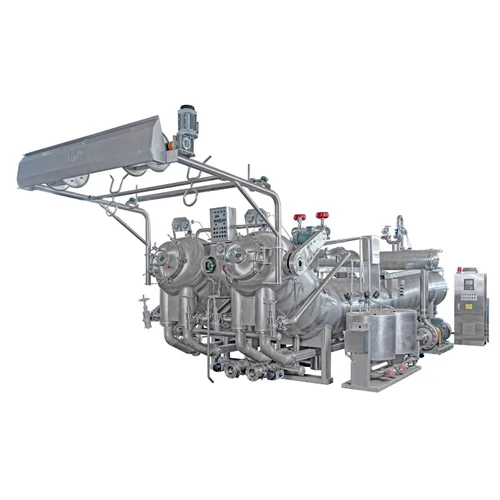
1. The body of the rope machine is short, the real silk squeezes each other at the rear, and the operation relies on the pulling force of the waist plate. The front is equipped with a silk frame grid, so that the dyeing operation is often in mechanical friction and self-friction. Japan's normal temperature overflow dyeing machine increases the length of the machine body and reduces the height of the cloth lifting roller and the liquid level. Driven by the start of the cloth lifting roller and the overflow of the dye liquor, the fabric runs and dyes, which effectively compensates for the rope machine The defects in the mechanical structure solve the inevitable ash defects of the rope machine in the dyeing of silk.
2. Japanese overflow dyeing machine, after starting the cloth lifting roller, the fabric immediately falls into the overflow pipe. Because the overflow pipe is vertical from top to bottom, the dyed fabric will go to the back of the liquid flow along with the overflow of the dye liquor. tube.
3. For Mezera double-pipe overflow dyeing machine, the elliptical overflow pipe extends backward on the upper inclined plane until the tail is broken, and the length is only more than 2m. If you dye broad fabrics or thicker fabrics, the rope-like cross-section will increase, which will cause difficulty in overflow, cause clogging, and make the fabric colored. So it is only suitable for the dyeing of light and thin fabrics.
4. The Japanese overflow dyeing machine is vertical overflow into the lower rectangular overflow pipe, its cross-sectional area is one-third larger than the oval overflow pipe, and the stretch length is 6~7m, which is not only suitable for light and thick fabrics, but also It is suitable for similar varieties of different door widths and has a wide range of adaptability.
https://www.tonghuadyeingmachine.com/