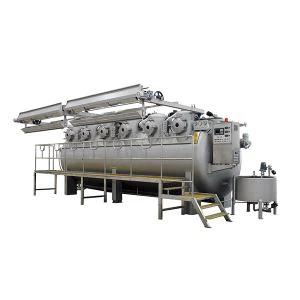
As a supplier of HTHP Rapid Jet Dyeing Machines, I often encounter inquiries about the machine's versatility, especially regarding its potential use for continuous dyeing. In this blog post, I will delve into the technical aspects, advantages, limitations, and practical applications to determine whether the HTHP Rapid Jet Dyeing Machine can indeed be used for continuous dyeing.
Technical Overview of HTHP Rapid Jet Dyeing Machine
The HTHP Rapid Jet Dyeing Machine, also known as the High Temperature and High Pressure Rapid Dyeing Machine, is a state - of - the - art piece of equipment designed for efficient and high - quality dyeing processes. It operates under high temperature and high pressure conditions, which significantly accelerate the dyeing process. The machine uses a jet system to circulate the dye liquor through the fabric at a high speed, ensuring uniform dye penetration and color distribution.
The key components of the HTHP Rapid Jet Dyeing Machine include a dyeing vessel, a heating system, a circulation pump, and a control system. The heating system can quickly raise the temperature of the dye liquor to the required level, and the circulation pump ensures that the dye liquor flows continuously through the fabric. The control system allows operators to precisely adjust parameters such as temperature, pressure, and dyeing time.
Principles of Continuous Dyeing
Continuous dyeing is a process in which fabric is dyed continuously as it passes through a series of dyeing units. The main advantage of continuous dyeing is its high production efficiency, as large quantities of fabric can be dyed in a relatively short period. In a typical continuous dyeing process, the fabric is first padded with the dye liquor, then passed through a steaming or baking unit to fix the dye.
The requirements for a machine to be suitable for continuous dyeing include a stable and continuous supply of dye liquor, the ability to handle high - speed fabric movement, and uniform dye application. Additionally, the machine should be able to maintain consistent temperature and pressure throughout the process.
Can HTHP Rapid Jet Dyeing Machine be Used for Continuous Dyeing?
Advantages
- Uniform Dyeing
The jet circulation system in the HTHP Rapid Jet Dyeing Machine ensures excellent dye penetration and uniform color distribution. This is crucial for continuous dyeing, as it helps to achieve consistent color across the entire length of the fabric. The high - speed circulation of the dye liquor can quickly transfer the dye to the fabric fibers, reducing the likelihood of color differences. - High - Speed Processing
With its rapid heating and circulation capabilities, the HTHP Rapid Jet Dyeing Machine can handle relatively high - speed fabric movement. This is in line with the requirements of continuous dyeing, where fabrics need to be processed at a fast pace to maximize production efficiency. The machine can quickly adjust to changes in fabric speed and maintain stable dyeing conditions. - Temperature and Pressure Control
The precise control system of the HTHP Rapid Jet Dyeing Machine allows for accurate regulation of temperature and pressure. In continuous dyeing, maintaining consistent temperature and pressure is essential for proper dye fixation. The machine can ensure that the dyeing process occurs under optimal conditions, resulting in high - quality dyed fabrics.
Limitations
- Batch - Oriented Design
The HTHP Rapid Jet Dyeing Machine is primarily designed for batch dyeing. It has a limited dyeing vessel capacity, which means that it needs to be loaded and unloaded periodically. In continuous dyeing, the process is continuous without such interruptions. This batch - oriented design may limit its suitability for large - scale continuous dyeing operations. - Fabric Handling
For continuous dyeing, the machine needs to be able to handle the continuous movement of fabric. While the HTHP Rapid Jet Dyeing Machine can handle high - speed fabric movement to some extent, it may face challenges in terms of fabric feeding and guiding. Special modifications may be required to ensure smooth and continuous fabric passage through the machine. - Dye Liquor Supply
In continuous dyeing, a continuous and stable supply of dye liquor is required. The HTHP Rapid Jet Dyeing Machine's dye liquor supply system is designed for batch operations, and it may need to be upgraded to meet the requirements of continuous dyeing. Ensuring a constant concentration of dye in the liquor is also a challenge, as the dye is continuously consumed during the process.
Practical Applications and Modifications
Despite its limitations, the HTHP Rapid Jet Dyeing Machine can be used for continuous dyeing in certain applications. For small - scale or niche continuous dyeing operations, the machine can be a cost - effective solution. For example, in the production of specialty fabrics or samples, where the production volume is relatively low, the HTHP Rapid Jet Dyeing Machine can be modified to suit continuous dyeing requirements.
Some possible modifications include:
- Continuous Fabric Feeding System
Installing a continuous fabric feeding system can help to overcome the batch - oriented design limitation. This system can ensure a smooth and continuous supply of fabric into the dyeing vessel, allowing for continuous dyeing. - Upgraded Dye Liquor Supply System
Modifying the dye liquor supply system to provide a continuous and stable supply of dye liquor is essential. This may involve adding a larger dye liquor tank, a more precise metering system, and a recirculation system to maintain the dye concentration. - Automated Control System
Enhancing the automated control system can help to better manage the continuous dyeing process. The system can monitor and adjust parameters such as temperature, pressure, and fabric speed in real - time, ensuring consistent dyeing quality.
Case Studies
There have been some successful cases of using modified HTHP Rapid Jet Dyeing Machines for continuous dyeing. In a small - scale textile factory, a HTHP Rapid Jet Dyeing Machine was modified with a continuous fabric feeding system and an upgraded dye liquor supply system. The factory was able to produce high - quality dyed fabrics for niche markets, such as high - end fashion brands. The modified machine allowed for more efficient production compared to traditional batch dyeing methods, while still maintaining the excellent dyeing quality that the HTHP Rapid Jet Dyeing Machine is known for.
Conclusion
In conclusion, while the HTHP Rapid Jet Dyeing Machine is primarily designed for batch dyeing, it has the potential to be used for continuous dyeing with appropriate modifications. Its advantages in terms of uniform dyeing, high - speed processing, and precise temperature and pressure control make it a viable option for certain continuous dyeing applications. However, its batch - oriented design, fabric handling limitations, and dye liquor supply challenges need to be addressed through modifications.
If you are interested in exploring the possibility of using our High Temperature and High Pressure Rapid Dyeing Machine or High Temperature and High Pressure Dyeing Machine or High Temperature Rapid Dyeing Machine for continuous dyeing, we are more than happy to discuss your specific requirements and provide customized solutions. Our team of experts can help you determine the best way to modify the machine to suit your continuous dyeing needs. Contact us to start a procurement discussion and take your dyeing operations to the next level.


References
- Textile Dyeing Technology Handbook, published by ABC Publishing House.
- Research Papers on Advanced Dyeing Machines, available in the Journal of Textile Engineering.