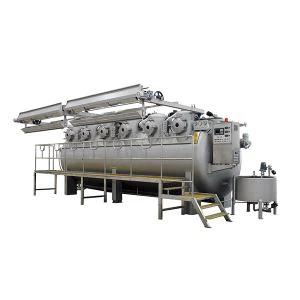
In the textile industry, the Rapid Jet Fabric Dyeing Machine has emerged as a revolutionary piece of equipment, offering high - efficiency and high - quality fabric dyeing solutions. As a supplier of Rapid Jet Fabric Dyeing Machines, I understand the importance of having a reliable communication interface for monitoring these machines. This blog post aims to explore the communication interfaces used in Rapid Jet Fabric Dyeing Machines for monitoring purposes.
The Significance of Monitoring in Rapid Jet Fabric Dyeing Machines
Before delving into the communication interfaces, it's crucial to understand why monitoring is so important in Rapid Jet Fabric Dyeing Machines. These machines operate under high - pressure and high - temperature conditions, and slight variations in parameters such as temperature, pressure, and flow rate can significantly affect the dyeing quality. Monitoring allows operators to keep track of these parameters in real - time, make timely adjustments, and ensure consistent dyeing results. Additionally, continuous monitoring helps in detecting potential malfunctions early, reducing downtime, and extending the lifespan of the machine.
Types of Communication Interfaces for Monitoring
Ethernet Interface
One of the most commonly used communication interfaces in modern Rapid Jet Fabric Dyeing Machines is the Ethernet interface. Ethernet offers several advantages for monitoring applications. Firstly, it provides high - speed data transfer, which is essential for real - time monitoring of multiple parameters. With Ethernet, large amounts of data can be transmitted quickly between the machine's sensors, controllers, and the monitoring system.
Secondly, Ethernet is a widely adopted standard, making it easy to integrate the dyeing machine with other devices in the factory network. This allows for centralized monitoring and control, where operators can access the machine's data from a remote location using a computer or a mobile device. For example, an operator can monitor the temperature and pressure of multiple dyeing machines simultaneously from a control room, improving operational efficiency.


Our HTHP Rapid Jet Dyeing Machine is equipped with an advanced Ethernet interface that enables seamless communication with the monitoring system. This allows for remote monitoring and control, ensuring that the dyeing process is always under optimal conditions.
Modbus Protocol
Modbus is another popular communication protocol used in Rapid Jet Fabric Dyeing Machines. It is an open - standard protocol that allows for easy communication between different devices, such as sensors, controllers, and monitoring software. Modbus operates over serial communication (RS - 232, RS - 485) or Ethernet, providing flexibility in system design.
The main advantage of Modbus is its simplicity and compatibility. Many sensors and controllers in the market support the Modbus protocol, making it easy to integrate new components into the existing monitoring system. For example, a temperature sensor with a Modbus interface can be easily connected to the machine's controller, and the data can be transmitted to the monitoring software for analysis.
Profibus
Profibus is a fieldbus communication protocol that is widely used in industrial automation, including the textile industry. It offers high - speed data transfer, reliability, and real - time performance. Profibus allows for the connection of multiple devices in a network, such as sensors, actuators, and controllers, creating a decentralized control system.
In a Rapid Jet Fabric Dyeing Machine, Profibus can be used to connect the various components of the machine, such as the pump, heater, and valve controllers. This enables real - time communication between these components, ensuring coordinated operation. For instance, the pump speed can be adjusted based on the flow rate measured by the sensor, and the heater can be controlled according to the temperature requirements. Our HTHP Long Tube Rapid Fabric Dyeing Machine utilizes the Profibus protocol for efficient communication between its components, enhancing the overall performance of the dyeing process.
Wireless Communication
With the advancement of wireless technology, wireless communication interfaces are also being increasingly used in Rapid Jet Fabric Dyeing Machines. Wireless communication offers the advantage of flexibility, as it eliminates the need for physical cables, making installation and maintenance easier.
Wi - Fi and Bluetooth are two common wireless communication technologies used in monitoring applications. Wi - Fi allows for long - range communication within the factory premises, enabling operators to monitor the machine's data from different locations. Bluetooth, on the other hand, is suitable for short - range communication, such as connecting a mobile device to the machine for local monitoring and configuration.
However, wireless communication also has some limitations, such as signal interference and security concerns. Therefore, proper measures need to be taken to ensure reliable and secure communication.
Integration of Communication Interfaces with Monitoring Software
The communication interfaces in Rapid Jet Fabric Dyeing Machines are typically integrated with monitoring software. This software provides a user - friendly interface for operators to view and analyze the machine's data. It can display real - time data in the form of graphs, charts, and tables, making it easy for operators to understand the machine's status.
The monitoring software can also generate alarms and notifications when certain parameters exceed the predefined limits. For example, if the temperature in the dyeing machine exceeds the safe limit, an alarm will be triggered, alerting the operator to take immediate action. Additionally, the software can store historical data for analysis and reporting, helping operators to identify trends and improve the dyeing process over time.
Our High Temperature Dyeing Machine is integrated with state - of - the - art monitoring software that provides comprehensive monitoring and control capabilities. The software is compatible with different communication interfaces, ensuring seamless integration with the machine's sensors and controllers.
Future Trends in Communication Interfaces for Monitoring
As technology continues to evolve, we can expect to see several trends in the communication interfaces for monitoring Rapid Jet Fabric Dyeing Machines. One of the trends is the increasing use of Internet of Things (IoT) technology. IoT enables the connection of devices to the internet, allowing for remote monitoring and control on a global scale. With IoT, operators can access the machine's data from anywhere in the world using a smartphone or a tablet, providing greater convenience and flexibility.
Another trend is the development of more intelligent and self - optimizing communication interfaces. These interfaces can automatically adjust the communication parameters based on the network conditions, ensuring reliable and efficient data transfer. Additionally, they can perform self - diagnosis and fault detection, reducing the need for manual intervention.
Conclusion
In conclusion, the communication interface is a crucial component of Rapid Jet Fabric Dyeing Machines for monitoring purposes. Ethernet, Modbus, Profibus, and wireless communication are some of the commonly used interfaces, each offering its own advantages. The integration of these interfaces with monitoring software provides operators with real - time data, alarms, and historical analysis capabilities, ensuring optimal operation of the dyeing machine.
As a supplier of Rapid Jet Fabric Dyeing Machines, we are committed to providing high - quality machines with advanced communication interfaces for monitoring. If you are interested in our products or have any questions about the communication interfaces, please feel free to contact us for a detailed discussion and procurement negotiation.
References
- Smith, J. (2018). Industrial Communication Protocols for Automation. New York: Elsevier.
- Brown, A. (2019). Textile Machinery Technology: Principles and Applications. London: Taylor & Francis.
- Wilson, R. (2020). Internet of Things in the Textile Industry. Berlin: Springer.