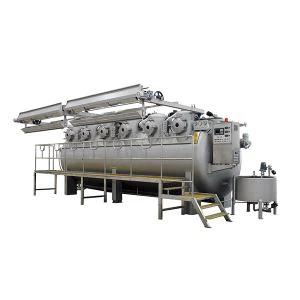
As a supplier of High Temperature Overflow Dyeing Machines, understanding the flow pattern of the dye liquor in these machines is crucial. It not only affects the quality of the dyeing process but also determines the efficiency and cost - effectiveness of the entire operation.
1. Basics of High Temperature Overflow Dyeing Machines
High Temperature Overflow Dyeing Machines are widely used in the textile industry for dyeing various types of fabrics. These machines operate at high temperatures, typically above 100°C, and use an overflow system to circulate the dye liquor. The high temperature helps to open up the fiber structure of the fabric, allowing the dye molecules to penetrate more easily and achieve a more uniform and fast - colored result.
The basic components of a High Temperature Overflow Dyeing Machine include a dyeing vessel, a circulation pump, a heat exchanger, and a control system. The dyeing vessel holds the fabric and the dye liquor. The circulation pump is responsible for moving the dye liquor through the system, while the heat exchanger maintains the desired temperature of the dye liquor. The control system monitors and adjusts various parameters such as temperature, pressure, and flow rate.
2. Flow Pattern of Dye Liquor
2.1 Initial Injection and Mixing
When the dyeing process starts, the dye liquor is first injected into the dyeing vessel. At this stage, the flow pattern is mainly characterized by a turbulent mixing process. The dye liquor is introduced at a relatively high velocity to ensure rapid and uniform distribution within the vessel. The turbulence helps to break up any clumps of dye and ensures that the dye is evenly dispersed in the water.
The initial injection also creates a pressure difference within the vessel, which drives the initial movement of the dye liquor. This pressure - driven flow helps to carry the dye to different parts of the fabric. However, if the injection velocity is too high, it may cause mechanical damage to the fabric, especially for delicate materials.
2.2 Circulation through the Fabric
Once the dye liquor is well - mixed in the vessel, the circulation pump takes over to maintain a continuous flow of the dye liquor through the fabric. The flow pattern at this stage is a combination of laminar and turbulent flow. In the areas where the dye liquor passes through the fabric, the flow is often laminar. This is because the fabric acts as a porous medium, which restricts the movement of the fluid and reduces the turbulence.
The laminar flow is beneficial for the dyeing process as it allows the dye molecules to have more time to interact with the fabric fibers. The dye molecules can diffuse into the fiber structure more effectively under laminar flow conditions. However, in some parts of the vessel where the dye liquor is not in direct contact with the fabric, the flow may still be turbulent. This helps to maintain the overall mixing of the dye liquor and prevent the formation of concentration gradients.
2.3 Return to the Circulation System
After passing through the fabric, the dye liquor returns to the circulation system. The flow pattern during this return process is again influenced by the design of the machine. In some High Temperature Overflow Dyeing Machines, there are specific channels or pipes that direct the flow of the dye liquor back to the pump. These channels are designed to minimize pressure losses and ensure a smooth return of the dye liquor.
The return flow also plays an important role in heat transfer. As the dye liquor passes through the fabric, it loses some heat to the fabric. The heat exchanger in the circulation system then restores the temperature of the dye liquor to the desired level before it is recirculated through the fabric.


3. Factors Affecting the Flow Pattern
3.1 Viscosity of Dye Liquor
The viscosity of the dye liquor has a significant impact on its flow pattern. A higher viscosity dye liquor will flow more slowly and may require a higher pressure to maintain the same flow rate. This can affect the distribution of the dye within the fabric. For example, if the viscosity is too high, the dye liquor may not be able to penetrate the fabric evenly, resulting in uneven dyeing.
The viscosity of the dye liquor can be affected by factors such as the concentration of the dye, the presence of additives, and the temperature. As the temperature increases, the viscosity of the dye liquor generally decreases, which can improve the flow characteristics.
3.2 Fabric Properties
The properties of the fabric, such as its porosity, density, and thickness, also influence the flow pattern of the dye liquor. A more porous fabric allows the dye liquor to flow through more easily, resulting in a more uniform dyeing. On the other hand, a dense or thick fabric may restrict the flow of the dye liquor, leading to uneven dyeing.
The fabric's surface characteristics can also affect the flow. For example, a fabric with a smooth surface may have less resistance to the flow of the dye liquor compared to a fabric with a rough surface.
3.3 Machine Design
The design of the High Temperature Overflow Dyeing Machine itself has a major impact on the flow pattern of the dye liquor. The shape and size of the dyeing vessel, the location and design of the injection nozzles, and the layout of the circulation system all play important roles.
For example, a well - designed dyeing vessel with a proper shape can promote better mixing and circulation of the dye liquor. The injection nozzles should be positioned to ensure uniform distribution of the dye liquor within the vessel. The circulation system should be designed to minimize pressure losses and provide a stable flow rate.
4. Importance of Understanding the Flow Pattern
4.1 Quality of Dyeing
A thorough understanding of the flow pattern of the dye liquor is essential for achieving high - quality dyeing results. By controlling the flow pattern, we can ensure that the dye is evenly distributed on the fabric, resulting in a uniform color and good color fastness. For example, if the flow pattern is not properly controlled, some parts of the fabric may receive more dye than others, leading to color variations.
4.2 Efficiency and Cost - Effectiveness
Understanding the flow pattern can also improve the efficiency of the dyeing process. By optimizing the flow rate and distribution of the dye liquor, we can reduce the dyeing time and the amount of dye used. This not only saves time and resources but also reduces the environmental impact of the dyeing process.
5. Our Company's Solutions
As a leading supplier of High Temperature Overflow Dyeing Machines, we have developed advanced technologies to optimize the flow pattern of the dye liquor. Our machines are designed with carefully engineered injection nozzles and circulation systems to ensure rapid and uniform distribution of the dye liquor.
We also offer a range of different types of dyeing machines to meet the diverse needs of our customers. For example, our High Temperature High Pressure Soft Flow Dyeing Machine is suitable for delicate fabrics, as it provides a gentle flow of the dye liquor to avoid fabric damage. Our Jet Dyeing Machine For Satin Fabric is specifically designed for satin fabrics, ensuring excellent dyeing results. And our High Temperature Low Tension Evenflow Dyeing Machine is ideal for fabrics that require low tension during the dyeing process.
6. Contact for Purchase and Negotiation
If you are interested in our High Temperature Overflow Dyeing Machines or have any questions about the flow pattern of the dye liquor, we welcome you to contact us for further discussion and negotiation. Our team of experts is ready to provide you with detailed information and customized solutions based on your specific requirements.
References
- Textile Dyeing Technology Handbook, published by a well - known textile research institute.
- Journal of Textile Science and Engineering, various articles on dyeing machine flow patterns.