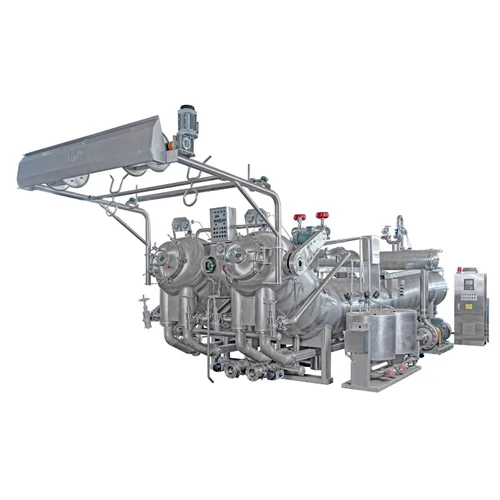
Fabric dyeing machines are specialized equipment used to apply color uniformly to textile fabrics in batch, semi-continuous, or continuous processes. They are selected based on fabric type (knit/woven), fiber composition, weight, sensitivity, and production scale. Below are the main types of fabric dyeing machines, categorized by design and operation principle:
1. Jet Dyeing Machine
* Principle: Fabric is propelled through a closed loop by a high-velocity jet of dye liquor.
* Best for: Knitted fabrics (especially polyester, nylon, and blends).
* Features:
Operates at high temperature (up to 140°C) and high pressure (HTHP).
Liquor ratio: 1:8 – 1:15.
High speed but higher mechanical stress.
* Limitation: Not ideal for delicate or lightweight elastic fabrics.
2. Soft Flow Dyeing Machine
* Principle: Combines gentle overflow circulation with mild jet or winch assistance for low-tension fabric movement.
* Best for: Delicate knits, spandex/Lycra® blends, silk, modal, Tencel™, fine cotton.
* Features:
Low fabric stress → minimal creasing or distortion.
Liquor ratio: 1:6 – 1:10.
Excellent for high-quality fashion and intimate apparel.
* Advantage: Superior fabric care with good dye uniformity.
3. Winch Dyeing Machine (Also called "Jigger" in some contexts, though technically different)
⚠️ Note: True winch = rope form; jigger = open-width.
* Principle: A rotating winch reel slowly pulls fabric through a stationary dye bath in rope form.
* Best for: Lightweight woven fabrics (e.g., cotton voile, silk, wool).
* Features:
Atmospheric pressure, max 100°C.
Very low tension and gentle handling.
High liquor ratio: 1:15 – 1:30.
* Drawback: Slow process, high water consumption-largely replaced by modern machines.
4. Jigger Dyeing Machine
* Principle: Fabric moves back and forth in open-width form over two large rollers immersed in dye liquor.
* Best for: Woven fabrics (cotton, linen, canvas) that must remain flat.
* Features:
Atmospheric, ≤100°C.
Prevents rope marks; maintains fabric width.
Simple, low-cost, but labor-intensive.
* Use today: Mostly in small-scale or traditional mills.
5. Airflow (Gas) Dyeing Machine
* Principle: Uses hot air instead of water to transport fabric through the dye chamber; dye is applied in minimal moisture.
* Best for: Polyester and synthetic fabrics.
* Features:
Ultra-low liquor ratio (1:3 – 1:5) → major water/energy savings.
No water turbulence → zero fabric abrasion.
Fast cycle times.
* Pioneer: DyeCoo (waterless CO₂ dyeing is a related but distinct technology).
6. HT (High-Temperature) Overflow Dyeing Machine
* Often grouped with soft flow machines.
* Uses overflow circulation only (no jet propulsion).
* Extremely gentle-used for very sensitive fabrics like lace or netting.
* Lower production speed but maximum fabric protection.
7. Garment Dyeing Machines (for finished products)
* While not strictly fabric machines, they dye cut-and-sewn garments.
* Types: Rotary drum, paddle, or jet-based.
* Used for vintage effects, soft hand feel (e.g., garment-dyed T-shirts, jeans).
Batch vs. Continuous Systems
| Type | Examples | Use Case |
| Batch | Jet, Soft Flow, Winch, Jigger | Small–medium lots, flexibility, high quality |
| Continuous | Pad-Steam, Thermosol ranges | Mass production (e.g., poplin, twill) |
Key Selection Criteria
* Fiber type (natural vs. synthetic)
* Fabric construction (knit vs. woven, weight, elasticity)
* Quality requirements (crease-free? soft hand?)
* Sustainability goals (water/energy reduction)
* Production volume
Modern dye houses often use a mix of jet and soft flow machines to handle both standard and premium fabric lines efficiently. As sustainability drives innovation, low-liquor-ratio and airflow systems are gaining popularity.