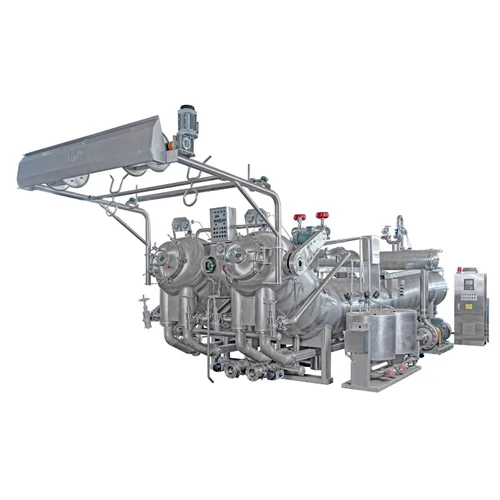
The liquor ratio in a jet dyeing machine refers to the ratio of the volume of dye liquor (in liters) to the weight of the dry fabric (in kilograms) being processed. It is expressed as L:R = X:1 (e.g., 10:1 means 10 liters of dye bath per 1 kg of fabric).
Typical Liquor Ratio for Jet Dyeing Machines
* Conventional Jet Dyeing Machines:
1:8 to 1:15 (i.e., 8–15 liters of liquor per kg of fabric)
* Modern Low-Liquor-Ratio Jet Machines:
1:6 to 1:8 (achieved through optimized tank design, efficient circulation, and reduced internal volume)
⚠️ Note: Older or poorly maintained machines may operate at higher ratios (up to 1:20), which increases water, chemical, and energy consumption.
Why Liquor Ratio Matters
| Factor | Impact of High Liquor Ratio | Benefit of Low Liquor Ratio |
| Water Consumption | High | Reduced by 30–50% |
| Chemical Usage | More dye & auxiliaries needed | Lower dosage, cost savings |
| Energy Use | More heat required to raise temp | Faster heating, lower steam/electricity use |
| Effluent Load | Higher wastewater volume & pollution | Easier & cheaper effluent treatment |
| Dyeing Quality | Risk of uneven dyeing if flow is poor | Better reproducibility & levelness (if machine is well-designed) |
Comparison with Other Dyeing Machines
| Machine Type | Typical Liquor Ratio |
| Jet Dyeing Machine | 1:8 – 1:15 |
| Soft Flow Dyeing Machine | 1:6 – 1:10 |
| Winch Dyeing Machine | 1:15 – 1:30 |
| Airflow (Gas) Dyeing Machine | 1:3 – 1:5 (ultra-low!) |
| HTHP Sample Dyer | 1:10 – 1:20 |
Industry Trend
There is a strong push toward reducing liquor ratios in jet dyeing machines to meet sustainability goals (e.g., ZDHC, EU Ecolabel). Innovations include:
* Smaller dye tanks with better fabric-to-liquor contact
* Variable-speed pumps for optimal flow at low volumes
* Advanced control systems to prevent fabric entanglement at low liquor ratios
✅ Best practice: Aim for ≤1:8 in modern production-this balances efficiency, quality, and eco-performance.